Introduction
Data integrity has become one of the most heavily scrutinized areas in pharmaceutical and biopharmaceutical manufacturing. As companies move away from paper-based systems toward computerized systems such as LIMS, MES, ERP, and chromatography data systems (CDS), the audit trail has emerged as one of the most important — and most frequently cited — elements in regulatory inspections. FDA Warning Letters, EMA findings, and MHRA data integrity guidance consistently flag inadequate audit trail review as a systemic failure, often linked to broader concerns about data reliability across a facility.
This article summarizes what audit trail review is, why it matters, and how to build a practical, risk-based approach that satisfies both regulatory expectations and day-to-day operational needs.
What Is an Audit Trail?
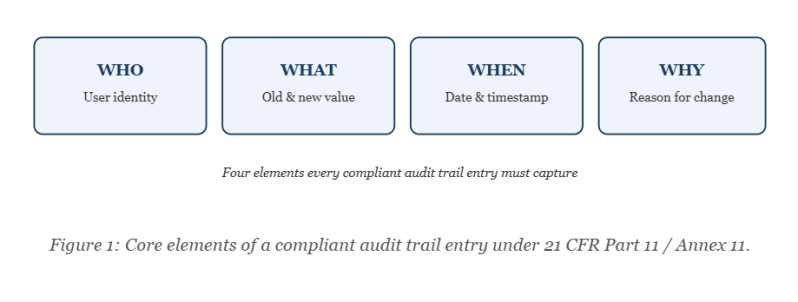
An audit trail is a secure, computer-generated, time-stamped electronic record that allows the reconstruction of events relating to the creation, modification, or deletion of GxP-critical data. Under 21 CFR Part 11 and EU GMP Annex 11, audit trails must capture:
- Who made a change (user identity)
- What was changed (original and new value)
- When the change occurred (date and time stamp)
- Why the change was made (reason, where applicable)
Unlike a static log, a compliant audit trail cannot be edited or disabled by users, including system administrators, and must remain available for the full retention period of the associated record.
Why Audit Trail Review Matters
Simply having audit trail functionality turned on is not sufficient. Regulators expect organizations to actively review audit trails as part of routine data verification — not just pull them out reactively during an investigation or inspection. Inadequate review has repeatedly appeared in FDA 483 observations and Warning Letters, particularly where:
- Audit trails were technically enabled but never reviewed
- Critical data changes (e.g., reprocessed chromatography results, backdated entries) went unnoticed
- No documented procedure existed defining review frequency, scope, or responsibility
An unreviewed audit trail provides no more assurance than no audit trail at all — the data exists, but no one is using it to verify integrity.
Regulatory Expectations
21 CFR Part 11 (FDA) requires secure, computer-generated audit trails for electronic records, with review as part of overall record verification.
EU GMP Annex 11 requires that audit trails be risk-assessed and that critical data changes be reviewed alongside the review of the record itself, not as a separate, disconnected activity.
FDA Data Integrity Guidance (2018) clarifies that audit trail review should be part of the routine data review process, performed by someone independent of the data generation, and documented.
WHO and PIC/S guidance reinforce a risk-based approach, encouraging companies to prioritize systems and data with the highest impact on product quality and patient safety.
The common thread across all these documents is that audit trail review must be systematic, risk-based, documented, and performed by qualified, independent personnel.
Building a Risk-Based Audit Trail Review Program
Given the volume of data generated by modern GxP systems, reviewing every audit trail entry line-by-line is neither realistic nor value-adding. A risk-based approach focuses review effort where it matters most.
1. Identify GxP-Critical Systems and Data
Start by mapping which systems generate data that directly impacts product quality, safety, or efficacy — for example, LIMS test results, MES batch records, environmental monitoring systems, and CDS chromatography data. Systems with higher impact warrant more frequent and detailed review.
2. Define Review Frequency and Trigger Points
Review frequency should be justified by risk: some audit trails may warrant review with every batch release, others on a periodic (weekly or monthly) basis. Trigger-based review — for example, whenever a result is invalidated, reprocessed, or manually adjusted — should supplement scheduled reviews.
3. Focus on Metadata, Not Just Data
Reviewers should pay particular attention to metadata surrounding critical decision points: timestamps around test failures, sequence of events before a result was accepted, user access outside normal working hours, and repeated reprocessing or reintegration of the same sample. These patterns are often more revealing than the raw data values themselves.
4. Ensure Reviewer Independence
The person reviewing the audit trail should not be the same person who generated the data. Independent review reduces the risk of self-verification bias and strengthens the credibility of the review in front of inspectors.
5. Document the Review
Every review should leave evidence: what was reviewed, by whom, when, and the outcome. A checklist or standardized review form tied to the batch record or test result is a practical way to demonstrate this without creating excessive documentation burden.
6. Leverage System Tools Where Possible
Modern systems increasingly offer audit trail reporting tools, exception-based reporting, and flagging of high-risk events (e.g., deletions, manual data entry, out-of-specification result changes). Leveraging these tools reduces manual burden and improves consistency of review.
Common Pitfalls to Avoid
- Treating audit trail review as a checkbox exercise rather than a genuine verification step
- Reviewing audit trails in isolation from the associated record, missing important context
- Lack of a written procedure defining scope, frequency, and responsibility
- Insufficient training for reviewers on what constitutes a red flag within an audit trail
- No escalation pathway when suspicious entries are identified
Conclusion
Audit trail review is no longer an optional best practice — it is a core expectation woven into current data integrity guidance from the FDA, EMA, WHO, and PIC/S. A well-designed, risk-based audit trail review program protects data integrity, supports patient safety, and significantly reduces regulatory risk during inspections. Rather than treating audit trails as a passive safety net, pharmaceutical and biopharmaceutical companies should build them into an active, documented, and independently reviewed part of their quality system.
References
- U.S. Food and Drug Administration. 21 CFR Part 11 – Electronic Records; Electronic Signatures. Code of Federal Regulations. ecfr.gov/current/title-21/chapter-I/subchapter-A/part-11
- U.S. Food and Drug Administration. Data Integrity and Compliance With Drug CGMP: Questions and Answers — Guidance for Industry, December 2018. fda.gov/.../data-integrity-and-compliance-drug-cgmp-questions-and-answers
- European Commission. EudraLex Volume 4, EU GMP Guidelines, Annex 11: Computerised Systems, Revision 1 (effective June 2011). health.ec.europa.eu/.../annex11_01-2011_en_0.pdf
- World Health Organization. Guideline on Data Integrity, WHO Technical Report Series, Annex 4. who.int/publications/m/item/annex4-trs-guideline-on-data-integrity
- Pharmaceutical Inspection Co-operation Scheme (PIC/S). Good Practices for Data Management and Integrity in Regulated GMP/GDP Environments, PI 041-1. picscheme.org/en/publications
Add comment
Comments